Why Did the Hiroshima Carp Select Takara Yamasato First Overall Without Competition? The Surprise and Opportunity Created by the “Zombie Cigarette” Scandal
October 27, 2026
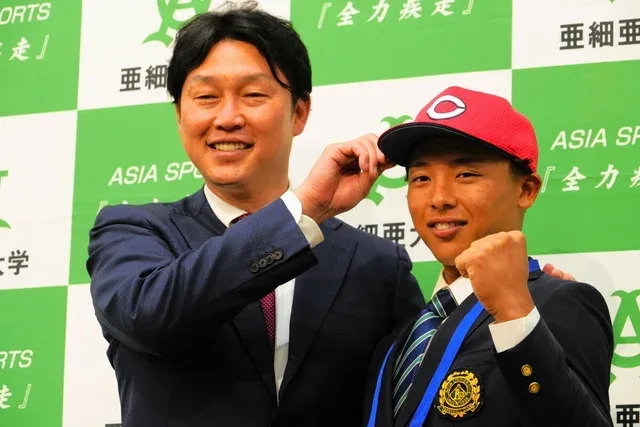
The 2026 NPB Draft produced several surprises, including the Hiroshima Carp’s decision to select infielder Takara Yamasato first overall without competition. Although Yamasato was not widely projected as a first-round pick, Hiroshima’s infield situation and the scarcity of college and corporate-league middle infielders likely made securing him a priority. The draft also saw a record number of college and corporate-league catchers selected, an unusual developmental pick of a junior high school student by the Yomiuri Giants, and five selections of players competing overseas.
The 2026 NPB Draft took place on October 22, with 127 players selected: 76 under standard roster contracts and 51 as developmental players. The moment that generated the biggest reaction was arguably the Yomiuri Giants’ decision to select Sho Oda, a pitcher from Yokohama High School who had expressed a desire to pursue a career in the United States.
Oda has stated that the Giants’ selection has not changed his intentions. However, the club announced the appointment of Hideki Matsui as its new manager the following day. Given Matsui’s extensive experience in Major League Baseball, there is a strong possibility that he will take part in negotiations with Oda. Whether the Giants can persuade Oda to reconsider could significantly affect how this year’s draft is ultimately judged.
Oda was not the only player involved in an unexpected selection. Several other picks also attracted attention.
Why Hiroshima Made Takara Yamasato Its First Overall Pick
One of the most notable selections was infielder Takara Yamasato, who joined the Hiroshima Carp from Asia University as the first overall pick.
Yamasato had already established a reputation for his defensive ability during his time at Kobe International University High School. He made considerable progress offensively at Asia University and was selected for Japan’s national university team this year.
Despite those credentials, few observers had projected him as a first-round pick. Reports suggesting that Hiroshima was considering him as its top choice only emerged shortly before the draft.
The background to the decision appears to involve two factors: the Carp’s infield situation following the release of three infielders in connection with the “zombie cigarette” scandal, and the limited number of highly regarded middle-infield prospects available in this year’s draft.
The three players named in this context were Kaito Kozono, Masaya Yano, and Seita Maekawa. Their departures left Hiroshima facing additional questions about its infield depth at a time when this draft offered few strong candidates for shortstop and second base.
In fact, among college and corporate-league middle infielders selected within the first three rounds, only two players were taken: Yamasato and Keigo Okada of Meiji University, who went to Rakuten in the second round.
Even if Hiroshima had planned to wait until the second round to address its middle-infield needs, Okada had already been selected. The Chiba Lotte Marines, who also appeared to have a shortage of middle infielders, could potentially have targeted Yamasato as well.
Given those circumstances, Hiroshima may have moved Yamasato up to the first overall pick to ensure that it secured him.
The selection may seem somewhat high relative to his projected draft position, but it gives Yamasato a significant opportunity with a team that needs help in the infield. He will now have the chance to make an impression from his rookie season and establish himself on the first team.
A Record Number of College and Corporate-League Catchers Selected
Another surprising feature of the standard roster draft was the number of college and corporate-league catchers selected. Eight players from those categories were picked, the highest total in the past 10 years.
One likely explanation is the lack of highly regarded high school catchers in this year’s draft pool.
Rintora Yamada of Chiben Wakayama High School was widely considered the top high school catching prospect, but he did not submit a professional application. In the end, only one high school catcher, Ryo Tanaka of Nihon University Third High School, was selected under a standard roster contract. Even then, Tanaka appears to have been evaluated primarily as a hitter rather than for his ability behind the plate.
The unusually high number of college and corporate-league catchers may also have been a reaction to last year’s draft, when Taiga Kojima of Meiji University, selected first overall by Seibu, was the only college or corporate-league catcher taken.
The four college catchers had been regarded as plausible draft candidates for some time. The four corporate-league selections, however, seemed to emerge as serious possibilities only shortly before the draft.
One of the biggest surprises was Riku Kamisato of ENEOS, selected by the Yokohama DeNA BayStars in the sixth round. Since he was not even his team’s regular starting catcher, many fans may have been caught off guard by his selection. His value appears to lie not only in his catching ability but also in his versatility as a player capable of playing the infield.
Tomohiro Shimizu of Yamaha, selected by Chunichi in the sixth round, was also highly rated for his hitting. The planned introduction of the designated hitter rule in the Central League next season may have worked in his favor as well.
This year’s draft served as another reminder of just how specialized the catcher position is, and how clubs may evaluate catchers for a variety of roles beyond their primary defensive responsibilities.
The Giants’ Developmental Pick of a Junior High School Catcher
The most talked-about selection in the developmental draft was arguably Rentaro Seki, a catcher in his third year of junior high school, who was selected by the Yomiuri Giants in the fifth round.
Seki plays for Tama River Boys, a youth baseball club operated by the Giants, and has also represented Japan on the Samurai Japan U-15 team. He is known for his strong arm and hitting ability.
He had reportedly turned down offers from several prestigious high schools. Within baseball circles, there had already been speculation that he might pursue a professional career without going through the conventional route of high school baseball. Nevertheless, his selection in this year’s draft was a significant development.
Under the current rules, players expected to graduate from junior high school are eligible to be drafted. Compared with students belonging to the Japan High School Baseball Federation or the All Japan University Baseball Federation, these players are also subject to fewer restrictions on approaches from NPB clubs.
The high school baseball federation is currently considering the introduction of seven-inning games. If more junior high school players want to pursue professional baseball early and compete at a high level in nine-inning games, it is entirely possible that others will follow a path similar to Seki’s.
The Giants are not the only NPB club operating youth teams for junior high school-age players. Rakuten and SoftBank also run clubs in this age group.
SoftBank, in particular, maintains a large developmental roster, much like the Giants. It would not be surprising if clubs like these increasingly pursued young prospects at an earlier age—a trend sometimes described as “poaching young talent.”
A More Global Draft
This year, five players competing overseas were selected across the standard and developmental drafts.
Some players, like Oda, are looking to pursue opportunities abroad. Others have gained experience overseas and then returned to Japan. The number of players following these different paths may continue to grow.
In that sense, the 2026 draft highlighted how Japanese professional baseball is becoming increasingly global, with clubs evaluating talent from a wider range of backgrounds and players pursuing more varied routes into the professional game.