Shodai Suekane's Struggles Continue in the Farm Team—but a Breakthrough May Finally Be Coming
September 14, 2026
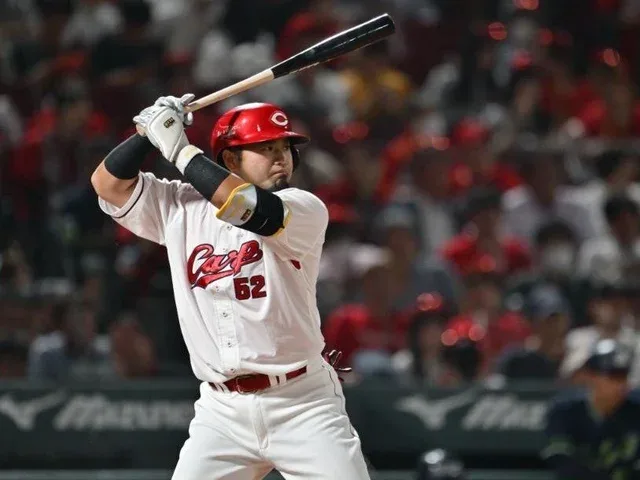
Shodai Suekane, one of Hiroshima's biggest power hitters, has yet to appear in a first-team game this season despite hitting 11 home runs and driving in 62 runs last year. After spending the entire season on the farm team, Suekane admits that his attempts to improve through repeated experimentation ultimately caused more problems than they solved. Now, however, the 30-year-old slugger says he is finally beginning to rediscover a swing he can trust.
Even as the NPB pennant race enters its final stages, Shodai Suekane remains absent from the Hiroshima Carp's first team.
That is a particularly surprising situation for a hitter who led all Japanese-born Hiroshima players with 11 home runs last season.
Suekane is not dealing with an injury. He has played in a team-high 85 farm games this season as of September 12, tying rookie Daiki Kishimoto for the most appearances on the Carp's farm roster. Both players have also reached the minimum number of plate appearances required for the farm batting title.
Yet Suekane has not received a single first-team call-up this season.
“Of course I'm frustrated, and I don't feel that I've lost to the players who are on the first team. But ultimately, it's because I'm not good enough right now. It's late, but I'm finally starting to feel like my swing is coming around. I sometimes wonder if things would have been different if I'd found this feeling earlier in the season.”
The numbers explain why Hiroshima has kept him in the minors.
Through September 12, Suekane was batting just .221 with five home runs and 28 RBIs in the farm league. Neither his batting average nor the power numbers expected from him have been good enough to force his way back onto the first-team roster.
The problem was not simply that he sacrificed contact for power—or that he sacrificed power in an attempt to become more consistent.
Instead, Suekane found himself caught between different approaches to hitting.
When Trial and Error Became More Error Than Trial
During spring training, Suekane showed flashes of the type of hitting that separated him from the younger players around him. He felt he was making progress.
But once the games began, the results failed to follow.
As younger players received opportunities and made strong impressions, Suekane found himself further and further away from a first-team opportunity.
“I started thinking that they were probably going to keep using the younger players for a while, and that I wasn't going to get called up anytime soon. So I thought, if I'm not going to be called up right now, I should try changing this and that to become even better.”
But the constant experimentation had an unintended consequence.
“I kept repeating trial and error, but in the end, there was more error than trial.”
What was supposed to be improvement gradually became counterproductive.
Over June and July, Suekane hit only one home run, and he was nowhere near the level needed to seriously challenge for a first-team promotion.
There have been voices within baseball who believe that simply giving a proven power hitter a chance in the first team could change his motivation and allow his bat to come alive.
Suekane has twice reached double-digit home runs during his career, and Hiroshima is not exactly overflowing with right-handed power.
But manager Takahiro Arai has kept him on the farm team since last year's fall camp, throughout spring training and into the regular season.
The message behind that decision appears to be much tougher than simply giving Suekane another opportunity.
He needs to produce results—and build the technical foundation necessary to sustain them.
The Importance of the Quality of His Outs
Tomohiro Asayama, who coached Suekane at the first-team level through last season and has watched his struggles this year as a member of the third-team staff, explained the situation.
“Considering his position on the team and his age, he needs to show it through results. Starting the season on the farm team carried the message that he needed to produce down there and come back.”
Asayama also revealed that Arai is paying close attention to more than just the numbers.
“Manager Arai watches the farm-team video. He's looking not only at the batting results, but also at the quality of the outs.”
That final point may be the key to understanding Suekane's development.
Last season was the first time in his professional career that he reached the required number of plate appearances. His 11 home runs ranked second on the team behind Sandro Fabian, while his 62 RBIs also ranked second.
But as the season progressed, opposing pitchers increasingly exposed weaknesses in his approach.
Inside pitches were attacked with velocity, while pitches away and down were frequently turned into breaking balls.
In today's data-driven game, once a weakness is identified, opposing teams will attack it relentlessly.
Suekane's numbers show exactly how dramatically his production changed.
Through June:
66 games / .263 batting average / 66 hits / 6 home runs / 39 RBIs / 24 walks
July onward:
57 games / .215 batting average / 40 hits / 5 home runs / 23 RBIs / 9 walks
The decline in walks is particularly telling. It suggests that the issue was not simply a lack of hits or home runs, but a broader deterioration in his ability to control at-bats.
Finally, Signs of a Turnaround
Now, however, Suekane believes he is finally beginning to see a path forward.
As the season entered its second half and the end of the schedule came into sight, something changed in his approach.
Perhaps it was the realization that the season could end without a single first-team at-bat.
Whatever the reason, Suekane has started September strongly. Through the farm team's game against the Hokkaido Nippon-Ham Fighters on September 6, he was batting .400 with one home run and four RBIs during the month.
More importantly, he says the improvement is not limited to the numbers.
“I've started to hit the ball hard to the opposite field even against left-handed pitchers, and I feel like I'm finally able to hit back against 150-km/h fastballs from right-handers. I'm feeling things in my approach and swing path that I've never felt before.”
That is potentially more important than a few good games.
After spending months changing his swing and experimenting with different approaches, Suekane finally believes he may have found something he can build on.
The 30-year-old slugger reached his “thirties” milestone this May, and at this stage of his career, Hiroshima needs more than the occasional home run. The Carp need him to establish a reliable foundation that can withstand the adjustments opposing pitchers will inevitably make.
For Suekane, the road back to the first team is still uncertain.
But after a season in which his attempts to improve sometimes led him further away from his goal, he is finally beginning to see the shape of the hitter he wants to become.
He has taken the long way around.
Now he has to make the most of what he has finally found.